
How it was made
Lead the Ganesh aarti
This is the whole recipe behind the clip above — both prompts that made it, in the order they were run, and what each block of them is for. Copy them, change what you like, and tag us in what you make.
- Makes
- One clip · 720p
- Steps
- 4
- Models
- Seedream 5 Pro · Ochra Recast
What you bring
One clear photo of the face, looking straight at the camera in good light. Only the face is taken from it — the kurta, the lamp, the crowd and the light all come from the film. Skip sunglasses, heavy filters and group shots.
Step 1: Start from a clip with a performance in it
The swap keeps everything except the face, so whatever you give it is what you get back: its framing, its grade, its grain, its crowd, its light. That is the point — you are not describing a scene to a model and hoping, you are handing it one that already works and changing who is in it. Trim to the exact section you want before you start; the length and the shape are taken from the clip, not from a setting.
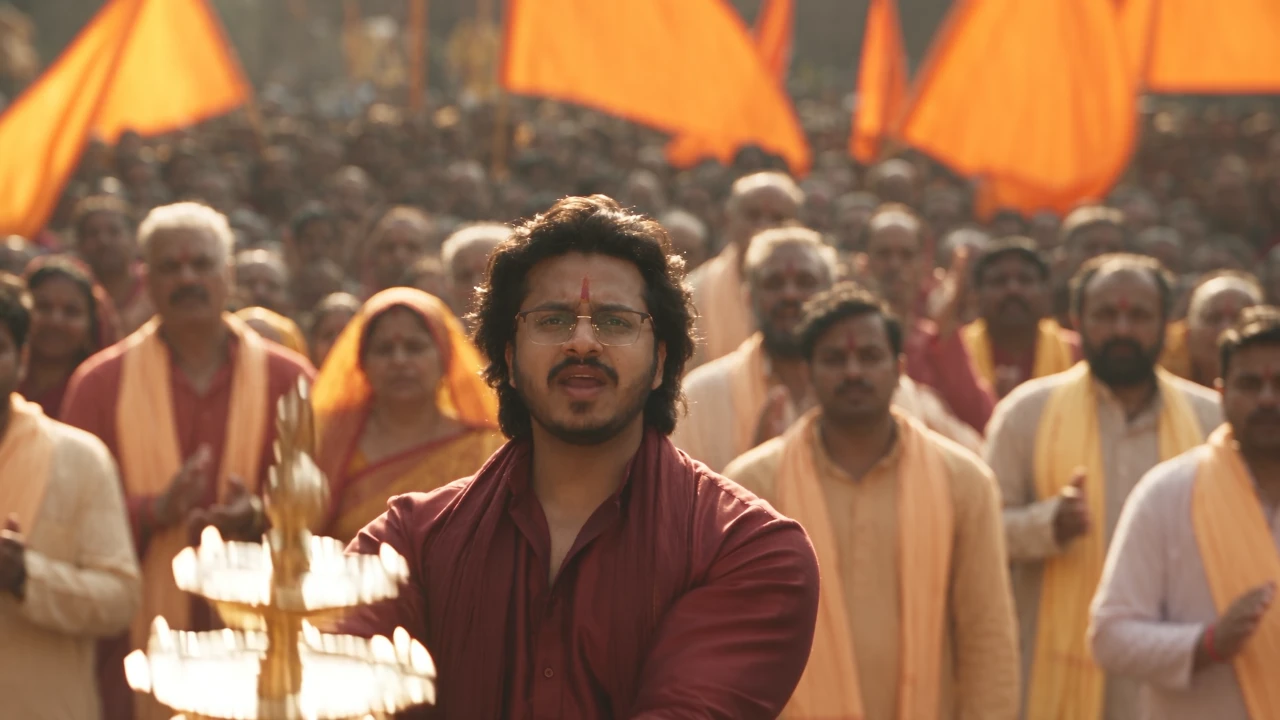 Ref 01
Step 2: Build a character sheet, not a selfie
One photograph gives the model one angle. A three-panel sheet — the face with the tilak, then the full outfit front and back — gives it the face AND the wardrobe it has to hold for the length of the clip. This is the step people skip, and it is the one that stops the identity drifting halfway through. Run this on an image model with your own photo as the reference, then use what comes out as the character in the next step.
 Ref 01
Paste into Seedream 5 Pro
2,877 characters
A waist-up studio photograph of a man turned three-quarters to the camera, shoulders square,
face turned back toward the lens, on a flat neutral warm mid-grey studio backdrop. He is a
South Asian man in his early thirties with warm brown skin showing natural visible texture —
readable pores, light stubble along the jaw, a light natural sheen rather than gloss. Short
dark hair, slightly tousled. His ears are bare.

He wears a rich deep-red traditional kurta in fine cotton-silk with a soft matte sheen, the
placket open at the chest with the top two buttons undone and a little of his collarbone
showing, and the full sleeves rolled loosely to just below the elbow so his forearms are bare.
Over it, a flowing deep-red stole draped over his left shoulder and falling long down his back
and chest, its edges finished with a narrow understated antique-gold border, the fabric light
enough to move.

A bold vertical red tilak runs up the centre of his forehead. On his left wrist a masculine
steel-and-black wristwatch with a clean dial; on his right wrist a stack of traditional
bracelets — an oxidised silver kada, two thin gold bangles and a red kalava thread.

Soft directional warm key light from camera-left at forty-five degrees, a weak amber bounce
from camera-right, a clean separation rim from behind, a small eyelight for crisp catchlights.
His expression is calm, confident and unposed, chin slightly lifted, eyes to the lens.

Palette of 60% deep red, 30% warm skin and neutral grey, 10% antique gold. Photorealistic ARRI
Alexa 35 capture, Kodak Vision3 250D response, soft cinematic falloff, natural skin texture,
cinematic film still.
IDENTITY (all panels): Use <<<image_1>>> as the strict facial identity reference. Preserve exact facial features, face shape, skin tone, hairstyle, and beard exactly as shown in the reference photo — do not alter.

FOREHEAD MARK: Add a long elongated red tilak mark on the forehead, traditional Maharashtrian devotional style, vertical shape, visible in panel 1.

OUTFIT (all panels):
- Vibrant red kurta, full sleeves, mandarin/band collar, knee-length, festive silk-blend fabric with subtle sheen
- White straight-cut pajama
- Kolhapuri leather chappal, traditional braided design

PANEL 1 (left third) — FACE/UPPER BODY CLOSE-UP: Front-facing, chest-up crop, facing camera directly, neutral calm expression, mouth closed, tilak clearly visible on forehead. Kurta collar visible.

PANEL 2 (center third) — FULL BODY FRONT: Full-body, front-facing, head cropped out (crop above chin), standing relaxed pose, full outfit visible top to bottom including chappal.

PANEL 3 (right third) — FULL BODY BACK: Full-body, back view, head cropped out, standing pose matching panel 2, back of kurta and pajama visible.

CONSISTENCY: Identical outfit color, fabric, and fit across all panels; identical lighting and background throughout.
Step 3: Swap the identity, and nothing else
Every block after the first exists to stop the model improving things. Left alone it will beautify the skin, warm the grade, soften the grain and recompose slightly — each defensible on its own, and together they make a shot that no longer cuts against the source. Read it as four rules. IDENTITY SWAP is the only change permitted. EXACT MATCH pins framing, grade, lighting, texture, background and subject, one clause each. HARD RULES forbid the improvements by name. And the NEGATIVE PROMPT lists them again, individually, because a long roll of specifics beats a short instruction to behave.
Paste into Ochra Recast
4,656 characters
Recreate the attached source frame @Video 1  as an exact 1:1 replica. Replace ONLY the person's identity with the attached reference character @Image 1 . Every other element of the frame stays byte-identical to the source. This is a replication task, not a reinterpretation.
IDENTITY SWAP RULE (the only change permitted)
Replace the face, head shape, hair, skin tone and texture, and body identity with @Image 1 , matched as precisely as the reference allows. Nothing about @Image 1 's own background, lighting, outfit, or pose carries over. Only who the person is changes. The person's pose, expression and wardrobe from the source frame are retained and simply performed by the new identity.
EXACT MATCH SPECIFICATION
Framing and composition: identical crop, identical subject scale in frame, identical headroom, identical camera height, identical lens character and perspective distortion, identical horizon line and vanishing points.
Color grade: identical white balance and colour temperature, identical tint, identical contrast curve including shadow and highlight rolloff, identical black level, identical saturation, identical per channel hue shifts, identical overall look.
Lighting: identical key light direction and intensity, identical fill light ratio, identical rim or edge light if present, identical softness and diffusion quality, identical shadow density, shape and falloff, identical practical light sources and their positions.
Texture and grain: identical film grain amount and structure, identical sharpness and micro contrast, identical lens softness or crispness, identical chromatic aberration at frame edges, identical halation around highlights, identical bloom.
Background: identical environment, identical depth of field and bokeh shape, every background object in the exact same position, same distance, same scale.
Subject: same pose, same body angle, same head tilt, same gaze direction, same facial expression, same hair placement and movement, same wardrobe, same fabric folds and drape, same accessories in the same positions.
HARD RULES
Do not restyle. Do not beautify. Do not clean up skin, wrinkles, blemishes, or imperfections present in the source. Do not recompose the frame. Do not add elements. Do not remove elements. Do not soften the grade toward a more polished or commercial look. Photographic realism only, never illustrative, painterly, or stylised. The output must be indistinguishable from the source frame except for the swapped identity.
NEGATIVE PROMPT
restyled, beautified, retouched, smoothed skin, cleaned up imperfections, recomposed frame, added objects, removed objects, changed background, moved background objects, different depth of field, different bokeh shape, changed lens, changed focal length, altered perspective, different camera height, cropped differently, extra headroom, less headroom, changed subject scale, illustration, painting, cartoon, anime, 3D render look, CGI plastic skin, waxy skin, over smoothed skin, glossy skin, beauty filter, airbrushed look, changed white balance, warmer grade, cooler grade, shifted tint, changed contrast, crushed blacks, blown highlights, different saturation, different hue balance, modern cinematic grade replacing the source grade, added grain, removed grain, changed sharpness, added chromatic aberration, removed chromatic aberration, added halation, removed halation, added bloom, removed bloom, changed lighting direction, changed lighting ratio, added rim light, removed rim light, harder shadows, softer shadows, new shadow shapes, changed pose, changed body angle, changed head tilt, changed gaze direction, changed facial expression, changed hairstyle, changed hair colour, changed wardrobe, changed fabric drape, missing accessories, extra accessories, identity drift, wrong face, blended face, morphed face, inconsistent identity across the frame, doubled features, extra limbs, extra fingers, deformed hands, distorted anatomy, text, watermark, logo, timestamp, subtitle, caption, UI overlay, border, frame within frame, letterbox bars added or removed, colour banding, posterization, oversharpening halos, motion blur where the source has none, added motion blur, removed intended motion blur, upscale artifacts, AI generated look, uncanny valley smoothing, plastic look, low resolution, compression artifacts beyond the source's own grain, mismatched lighting on the swapped face, seams around the face, visible mask edge, floating face, misaligned face geometry, wrong skin tone for the lighting, flat frontal lighting replacing directional lighting, denoised texture, lost fine detail, lost pore texture, lost fabric texture.
Step 4: What to change when you want it to be yours
OUTFIT in the character sheet is the first thing to rewrite: the red kurta and the tilak belong to this scene, and a different song wants different clothes. Leave IDENTITY and CONSISTENCY as they are — those are what hold the face together across the panels. In the swap prompt, leave EXACT MATCH and the NEGATIVE PROMPT alone. They are long because they are doing the work. The only line worth touching is the first, and only to point at a different source clip.
That is the whole recipe.
Everything above is already filled in if you start from the template.
Use this template